
Port Scheduling Software
Optimize Vessel Scheduling, Berth Allocation and Terminal Operations
Reduce vessel waiting times, improve berth utilization, and increase terminal throughput with advanced port scheduling software designed for ports, marine terminals, liquid bulk terminals, and refineries.
Dropboard helps planners and operators make better decisions by combining operational scheduling, real-time visibility, and scenario-based decision support in a single platform.
Key Benefits
> Reduce vessel waiting times and congestion
> Improve berth and jetty utilization
> Minimize demurrage and operational delays
> Increase terminal throughput without major capital investment
> Improve planning efficiency and operational visibility
> Evaluate alternative operating strategies before implementation
Built for Complex Marine Operations
Marine and terminal operations involve far more than simply assigning vessels to available berths.
Planners must balance
Dropboard enables organizations to manage these complexities through intelligent scheduling and operational decision support.

Port and Marine Terminal Scheduling
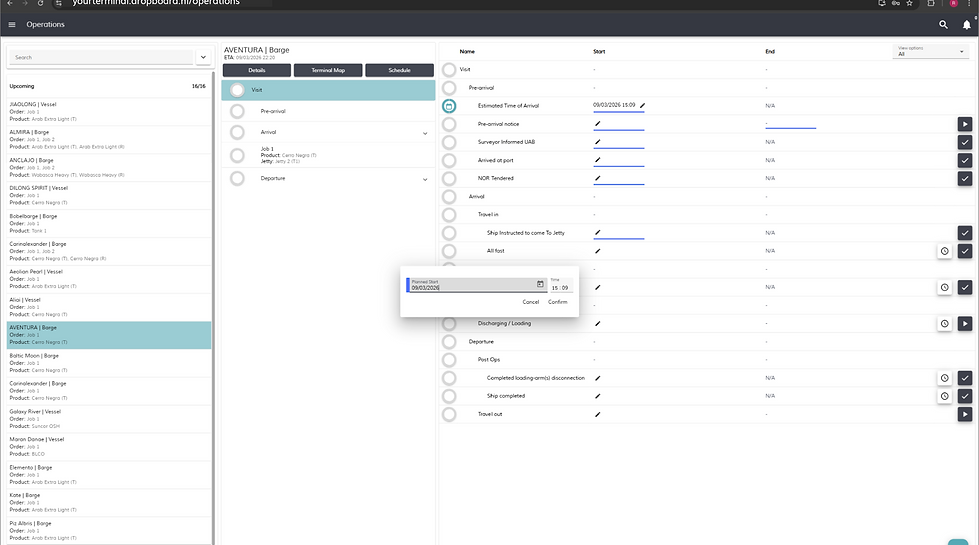
Dropboard provides a centralized platform for planning and managing vessel traffic across one or multiple terminals.
By providing planners with a complete operational picture, Dropboard helps reduce bottlenecks and improve asset utilization.
Vessel Call Timeline
NOR
First Line
Job Start
Unmooring
ETA
POB
All Fast
Job End
Let Go
AI-Powered Vessel Turnaround Predictions
Accurate scheduling depends on accurately predicting how long a vessel or barge will occupy a berth or jetty.
Many scheduling systems rely on fixed assumptions or manually estimated turnaround times. In reality, vessel occupancy durations are influenced by numerous factors including vessel characteristics, cargo type, product volumes, terminal conditions, weather, operational practices, and resource availability.
Dropboard continuously records detailed operational timestamps throughout the vessel lifecycle, creating a valuable operational dataset that can be used to improve future planning accuracy.
From Historical Data to Better Predictions
Using machine learning techniques, historical operational data can be analyzed to identify patterns and factors that influence berth occupancy duration.
Examples of recorded events include:
By analyzing thousands of historical vessel calls, the platform can learn from actual operational performance rather than relying solely on engineering assumptions or planner experience.

Improving Schedule Accuracy
Machine learning models can evaluate historical relationships between:
> Time of day/day of week/month of year
> Weather conditions
> Terminal congestion
The resulting predictions help planners estimate berth occupancy durations with greater accuracy and confidence.
Benefits include:
-
More realistic schedules
-
Reduced berth conflicts
-
Improved resource utilization
-
Better operational predictability
-
Reduced vessel waiting times
-
Lower demurrage exposure

Continuously Learning Operations
Unlike static planning parameters, AI-driven prediction models can continuously improve as new operational data becomes available.
As additional vessel calls, barges, cargo movements, and operational events are recorded, the prediction models can be retrained to reflect current operating conditions and changing terminal performance.
This enables terminal operators to transform operational history into a continuously improving decision-support capability.
Combining AI, Scheduling and Digital Twins
The greatest value is achieved when machine learning predictions are combined with operational scheduling and simulation-based digital twins.
Dropboard can use AI-generated occupancy predictions as inputs for scheduling and scenario analysis, allowing organizations to evaluate future operating plans using realistic operational assumptions derived from actual terminal performance
The result is a more intelligent planning environment that combines:
This helps planners move beyond reactive scheduling and toward predictive, data-driven operations.
Liquid Bulk Terminal Operations
For liquid bulk terminals and refinery marine logistics operations, scheduling decisions are often influenced by product movements, tank availability, and pipeline constraints.
Dropboard supports:
The result is improved throughput, reduced delays, and more efficient use of terminal infrastructure.
Typical Applications
Ports
-
Vessel traffic planning
-
Berth allocation
-
Capacity planning
-
Infrastructure development
-
Resource planning
Marine Terminals
-
Vessel scheduling
-
Jetty utilization optimization
-
Operational planning
-
Resource management
Refineries
-
Crude supply logistics
-
Marine-terminal coordination
-
Feedstock planning
-
Marine inventory management
Liquid Terminals
-
Vessel scheduling
-
Operations logging
-
Throughput optimization
-
Outage planning
-
Resource planning

Improve Key Performance Indicators
Organizations implementing structured scheduling and decision-support processes can achieve significant operational improvements.
Areas of Impact
KPI | Potential Improvement |
|---|---|
Schedule Reliability | Improved predictability & truct |
Demurrage Exposure | Lower delay-related costs |
Planning Efficiency | Reduced manual effort |
Throughput Capacity | Increased operational capacity |
Berth Utilization | Improved asset utilization |
Vessel Waiting Time | Reduced congestion and delays |
Actual results depend on terminal configuration, operating procedures, and business objectives.
Why Systems Navigator?
For more than two decades, Systems Navigator has helped organizations improve complex logistics and industrial operations through simulation, scheduling, optimization, and digital twin technologies.
Our experience spans:
> Offshore wind logistics
> Waterway authorities
> Manufacturing and supply chain operations
> Capital project logistics
Unlike generic scheduling tools, our solutions are designed specifically for complex, resource-constrained industrial environments.
Request a Demo | Schedule a Consultation
See how Dropboard can help your organization improve vessel scheduling, berth allocation, terminal utilization, and operational performance.
Schedule a demonstration today and discover how advanced scheduling and simulation can support better operational decisions.