
Making Capacity Visible: How Simulation & AI Are Transforming Batch Manufacturing
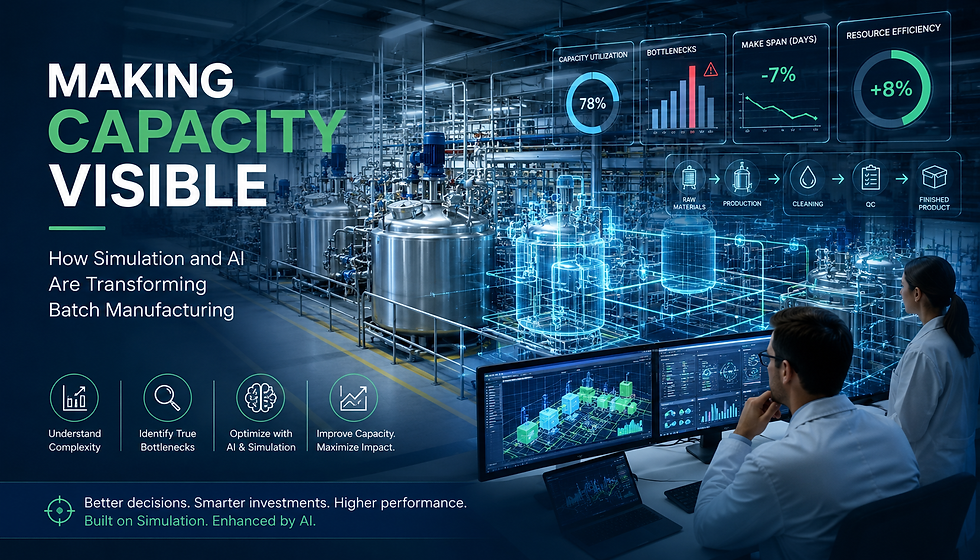
Project at a Glance
Over the past decade, Systems Navigator has supported a large-scale European biotechnology manufacturing facility with a simulation-based decision support platform designed to answer one recurring question:
Where should we invest next to unlock production capacity?
What began as a strategic capacity assessment developed into a comprehensive analytical framework that integrates discrete-event simulation with AI-driven sequence optimization. This platform has been employed in numerous extensive expansion studies to aid in investment decisions, debottlenecking efforts, and operational enhancement programs. Concurrently, the project laid the groundwork for future operational scheduling capabilities, driven by advanced analytics and artificial intelligence.
The Challenge of Planning in Batch Manufacturing
Planning production in complex batch manufacturing environments is inherently difficult. Biological and chemical production processes are often characterized by variability, strict process dependencies, cleaning requirements, limited shared resources, and highly dynamic bottlenecks. Small changes in sequencing or equipment utilization can have significant downstream impacts on throughput and efficiency.
Typical operational challenges included:
Planning processes heavily dependent on spreadsheets and expert knowledge
Limited visibility into the true system bottlenecks
Hidden capacity losses caused by interactions between process areas
Difficulty validating investment decisions before committing CAPEX
Limited ability to test alternative production strategies under uncertainty
As production demand increased and product portfolios became more diverse, the need for a fact-based decision support capability became increasingly important.
From Static Planning to Dynamic Decision Support
To address these challenges, Systems Navigator developed a detailed yet pragmatic simulation model of the manufacturing facility.
The model represented:
Core batch production processes
Batch splitting and combining logic
Shared utilities and constrained equipment
Cleaning and changeover activities
Waiting logic and process dependencies
Product-specific recipes and operational rules
To better reflect real-world operations, the simulation incorporated stochastic behavior across several critical dimensions:
Process duration variability
Yield variability
Quality control outcomes
Equipment availability effects
This allowed the organization not only to evaluate average performance, but also to assess the robustness of investment and operational decisions under uncertainty.
Identifying the Real Bottlenecks
The simulation platform was used to evaluate hundreds of strategic scenarios and investment combinations.
Rather than relying on static assumptions, the model enabled the team to test how the facility would behave under changing production volumes, product mixes, and operational constraints.
Key questions included:
Where does capacity actually break first?
Which investments deliver the highest operational impact?
How do bottlenecks shift under different demand scenarios?
Which constraints are structural versus sequence-dependent?
The studies revealed that several perceived bottlenecks were not the true limiting factors. In multiple cases, relatively small operational or equipment adjustments delivered disproportionate performance improvements.
In one recent six-month horizon study, the analysis identified a combination of low-capital interventions projected to reduce total make span by approximately 7% while simultaneously lowering machine-hour consumption by roughly 8%.
Beyond numerical results, the model also became an important communication and alignment tool across engineering, operations, and management teams. Visualizing system behavior helped stakeholders better understand the consequences of decisions and accelerated consensus around investment priorities.
Combining Simulation and AI
To further extend the value of the platform, Systems Navigator collaborated with a Dutch technical university on an AI-driven batch sequence optimization initiative.
The concept was straightforward but powerful:
Starting from a predefined production plan, the AI optimizer generates alternative production sequences, which are then evaluated automatically within the simulation environment against operational KPIs.
This integration between AI and simulation enables the exploration of thousands of realistic scheduling alternatives — far beyond what would be feasible manually.
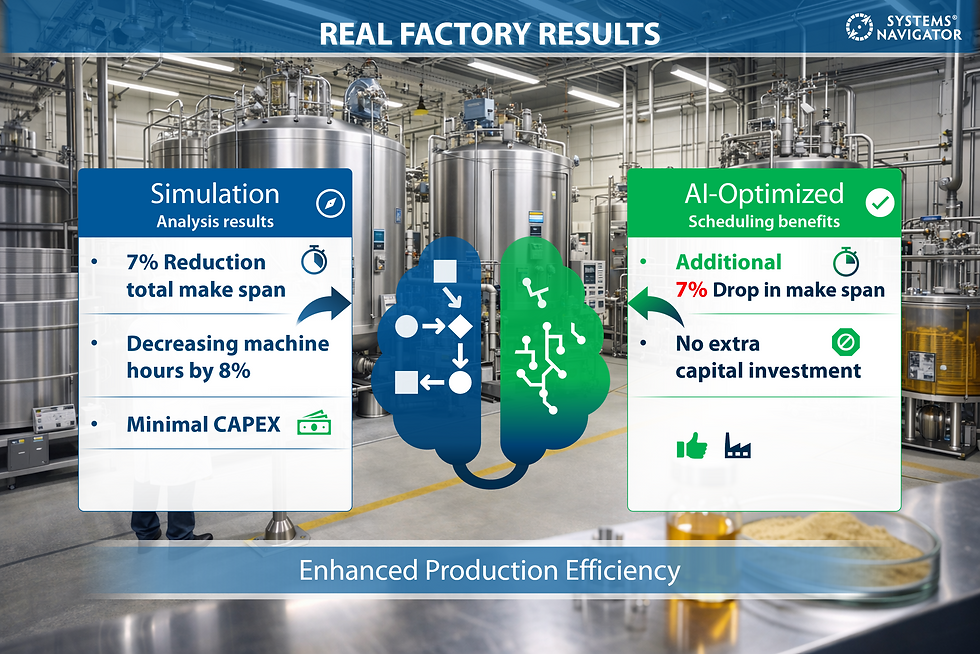
Preliminary results demonstrated measurable improvements in overall production performance without requiring additional capital investment. By optimizing production sequencing alone, the system achieved reductions in overall make span while improving resource utilization and operational stability.
While still evolving toward operational deployment, the project demonstrates the growing potential of combining:
Simulation technology
AI optimization
Advanced scheduling
Scenario-based decision support within complex industrial manufacturing environments.
A Broader Industry Perspective
Although developed for a highly specialized production environment, the underlying methodology is broadly transferable.
Many batch-oriented industries face similar challenges:
Pharmaceuticals
Biotechnology
Food and ingredients manufacturing
Specialty chemicals
Fermentation-based production
Fine chemicals
Across these sectors, organizations are increasingly looking for ways to move beyond static planning approaches toward more adaptive, data-driven operational decision making.
Simulation provides the ability to understand system behavior before making changes. AI introduces the ability to explore optimization opportunities at a scale that would otherwise be impossible.
Together, they create a powerful framework for improving utilization, reducing uncertainty, and supporting smarter industrial investment decisions.
Looking Ahead
As industrial operations become more complex and supply chains continue to face uncertainty, the ability to make capacity visible will become increasingly important.
The combination of simulation, AI, and operational analytics is no longer a theoretical concept. It is rapidly becoming a practical decision-support capability for organizations seeking higher efficiency, lower risk, and better long-term investment outcomes.
For many manufacturers, the next competitive advantage may not come from building more capacity — but from understanding and utilizing existing capacity more intelligently.



Comments